An Extended Conversation on Small Business Ecosystems with Brendan McCluskey
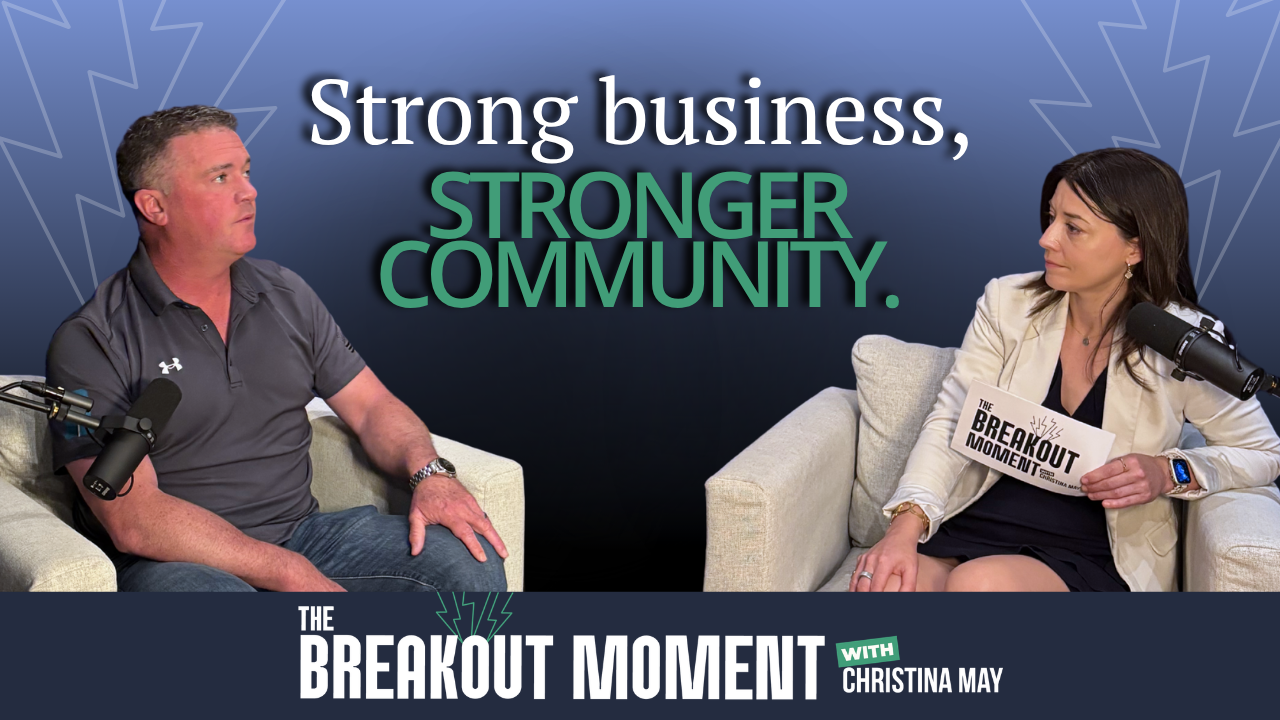
Last week, Christina talked with Brendan McCluskey of Trident Builders about community building and effective leadership. Before the cameras officially started rolling, they discussed the broader impacts of small businesses in their respective industries. Snap decisions can deeply affect long-term efficacy and stability in an organization. Brendan’s perspective and advocacy for employees at all levels of a business were too profound to leave on the cutting room floor. This week’s episode of The Breakout Moment is an exclusive look into their conversation.
Christina May: Having a broader perspective and broader experiences. And when you have a bunch of people that are all around the same age, same experience level, and I'm not talking about intelligence, I'm talking about life shit. The life shit is what shapes who you are and what you bring into work and everything else. So you're talking about the 47-year-old you has a very different worldview than the 22-year-old you. Same thing for me.
Brendan McCluskey: Yeah. I mean, I was definitely a jabroni then, and I'm just an older, grayer jabroni now. But it's true. I mean, I feel as if I haven't really developed mentally or grown. I just have a lot more responsibilities and mouths to feed, but you're right. I feel as if I've been really humbled in my journey. And when we go into the conversation about things, why am I working on the stuff that I'm working on? And it's like, I feel as if I keep on going, like upside the head. It's like, focus on this, right? It’s like, no, you're not going to have a big nice house on the water until you solve this problem.
CM: Yeah, no, same. It's funny how it just keeps bringing you back to the same thing until you finally face it and solve it. If you go off and chase, it's just kind of I just watched the last, I would say, 6 or 7 years; I keep getting slapped back to the same spot. It's starting to feel like Groundhog Day. I'm getting pissed, to be honest with you. But it's funny how life you have an experience, you bring it back in, you look at it differently, you learn from it, and you move on. I wish there were more of that in the room when it comes to artificial intelligence, and it's not the technology that scares me; it's the speed. It's almost like you're going so fast. You're missing key things that you don't realize you're missing because you haven't lived that yet.
BM: Well, and this is where it's going to be just so disruptive. The Industrial Revolution took 100 years to unfold. The information age took 20. This is going to take what, 2 to 5 maybe Max. Right.
CM: Yeah.
BM: And you know I’m good.
CM: Where's the bubble in there? Because every one of these comes with the bubble.
BM: Yeah, exactly right. And yeah, it can be a very disruptive job because I studied everything other than construction engineering as an undergrad. I changed my major like seven times.
CM: That does not surprise me.
BM: Yeah. And I was like, I just gotta get the hell out of college. I got a business degree, and I showed up as a glorified intern with a large-scale DC general contractor, and I fell in love with it. But I learned electrical engineering and structural engineering and all of that stuff. As well as the construction industry and product data by reviewing thousands upon thousands of documents over a ten-year period, so that was earned wisdom and earned knowledge. Who's gonna do that? Or this is the version of myself that's 22 years old, right? That should be in a trailer somewhere, just reading product data. That is mind-numbing. Are they doing that anymore? I don't know what that looks like, but I don't think they're going to have in their brain just the library of knowledge of the difference between granite and marble, you know? They are not going to possess that sort of nuanced knowledge of one versus the other.
CM: Well, I think the thing that really gets me with this is you have to bring context and creativity to everything. Your learned experience is how you bring those two things. With an LLM, it's only going to spit back out what its inputs are. Whereas those of us who have done algebra longhand, I always say within the office, you have to learn the rules to break the rules. Everybody wants to immediately jump into our business and immediately be a strategist, you know, being Oz behind the curtain going there. And I'm like, you can't do any of that until you've actually done the things themselves. Then you know how to break the rules. You know, if I pull this lever over here that works over there, or when I see this problem over here, this thing that is completely unrelated actually could solve it. I feel like this whole technology situation is just creating more have and have nots, which I know is a huge theme for you beyond just the technology, but we're just seeing more and more of a chasm when it comes to AI. A study came out; ChatGPT released a study of the actual usage, what people were using it for, and it was mind-blowing. It's being used more for personal than it is for business. But the thing that I really latched on to was that there was a direct correlation between your education level and how much you were using the technology. So this reminds me of the kind of information age. Internet came on; it was supposed to be a democratizing, level-playing-field situation. Now, small companies have more resources than big companies did before. And it was true to a point. But it actually ended up creating a bigger acceleration for those big companies. Amazons of the world, etc. Small companies are still trying to catch up. Well, what was interesting about the ChatGPT study was kind of the same thing. The more education you had, the more you were using this tool; the less education, the less you were using this tool. Just high school or associate's or not even, you were barely touching this tool. So those that are already highly educated, who already have a lot of resources, are using this tool and just blasting forward for the most part. Based on what they disclosed, the whole idea was it was supposed to create this playground. Anybody can use it for free to do more, faster, better, etc.
BM: Well, I think we could achieve that if we're very deliberate with what it is, how we deploy it, and how we build systems for it. Again, this is the stuff that I'm really actively working on, right? In 0809, one of the things I was working on was before I went out to Aspen, Colorado, when it really hit the fan. One of the things, as the market was softening up, was that we started to witness the bigger GCs were starting to eat their way down the food chain. They were trying to keep their payroll, keep their people on payroll, and keep their size and everything else. But then, when the market crashed itself, he responded, they kind of went back to their appropriate weight class. I see AI; they're going to eat their way down, and they're not going to leave. If they're able to do more volume of work and do less sophisticated projects because they're easy to automate and they have access to the resources, what they're going to do is they're going to basically box out the small business class. So one of the things that I'm working very hard on, and this speaks to everything. When we actually get into the interview, I guess.
CM: Yeah. We're going to start that here in a minute.
BM: One of the things that we are, I'm very deliberate about, is that I want to build a tool that is designed with the small GC in mind. To basically give them the resources and give them the ability to incorporate, say, solid project practices and to improve quality control and productivity out on the job site, which is a problem, is one of the reasons it's driving our construction cost and the lack of housing. It's fundamentally a problem. I need to solve these problems for myself. But what if we unleash all of the other small builders? Because right now it's so perverse. The ten biggest homebuilders in the country account for 25% of all housing inventory. However, 91% of home builders are considered small businesses. So think about what is going to happen if the big guys, who have the capital, are able to just eat the entire economy. What does our broader economy look like if the small business ecosystem is just destroyed? And I'm just talking about construction and homebuilding.
CM: Oh no, everything's on the table.
BM: Everything's on the table.
CM: Everything's on the table right now.
BM: Like restaurants, media companies.
CM: Yep. All of us.
BM: Sometimes what I've learned is that doing the right thing is also the smart thing. I feel as if it depends upon where you are in the space and where your heart is, and how you think about problems. But I feel as if everything I'm doing is not just the right thing to do, but it's the smart business decision. I feel very blessed for that. I really feel as if I've been slapped around; you've talked about this yourself. I was slapped upside the head. And it’slike Brendan, pay attention to this problem. Figure it out. I’ve bestowed you with the experiences and the knowledge of the know-how, okay?
CM: Just stay focused.
BM: Stay focused on this one problem, and it started with a vacancy, right? But of course, in my professional journey, I just happen to have a unique experience of working for some of the best construction management and construction management firms in the country, and developers also really understand the issues with housing. Then also energy and what the energy markets look like and understanding when energy's the most expensive and then to win a project out from underneath. Whiting Turner and Harkkins at the Smithsonian felt phenomenal. But again, that too was an arduous journey because I learned everything about passive house and penalized modular construction. Again, it was an expensive, hard project because I had an architect abjectly fail the thing. So we were forced to learn the stuff internally. The light bulb really kind of went off in my head; this is the scalable solution to the vacant crisis of Baltimore. It is the only way we're going to do it, right? You can't throw $400,000 into a row home and sell for 250. And we've been doing that for 50 years. And not only that, every trend in the market is working against us, right? Like materials are more expensive than they were five years ago. Labor is facing a crisis, right? We've got 1 in 4 construction workers is over the age of 55, and the average age of construction workers is 43 years old. We are simply not creating as many construction workers as we are losing every year.
CM: No, I mean it's awful.
BM: Yeah. But at the same time, we have this perverse problem where we have no construction workers, but then we have all this underemployed youth in Baltimore, right, who have been failed by every institution in their life, predominantly the schools. So these kids can't get themselves into a proper apprenticeship program because they don't have the academic rigor to get through the entrance exams. Why? Because other people have failed them. Now society has failed them. And the circumstances are such that it's like, okay, let's figure out a scalable solution as we reconstitute our workforce. We are able to have a younger workforce that's more productive. No 40- or 50-year-old is moving as fast as a 25-year-old Hagen sheet rock. All right, just calling it what it is. The bones hurt when you start getting into 45, 46, and 47 years old.
CM: Yeah, they do. Yeah, they do.
BM: So, it might be really good at the finishing side of it, but the arduous labor part of it, AI is not replacing that anytime soon.
CM: No.
BM: And so it goes back to your point about who's using AI the least, right? Well, it's the ones that I can't touch, and it's not coming anytime soon. Like I say, hanging sheetrock, you know, or picking up trash or any of it. It's not to do any of it.
CM: So I'm going to, like, hard-stop us so we can actually get this. It could be a bonus at this point because I think you've got like 20+ minutes already. Yeah. All right. Let me reset this. All right? You let me know when you're good. We're good?
BM: You know what was probably good about that entire exchange? It allows us to define the contours of the playing field.
CM: Yeah, it does. That's how this typically works. The pre-banter is what really shapes it. And then when it starts rolling, it just feels like a continuation of that original conversation.
So that's good. So..
Brendan, welcome to the breakout moment.
BM: Thank you, Christina. Thank you for having me.
CM: I am so happy you are here. We have had some spirited conversations over the years, so I'm excited to see where this goes. I think just kind of to kick things off, you and I were talking right away. First off, even the idea of a moment, how we have moments every day in the shower, this morning, while we were talking a couple minutes ago and and just as a business owner, how that just comes at you at breakneck speed no matter what, whether it's a little moment or a big moment.
So, one of the things that we were first kicking off and, you and I talking about everybody's talking about right now is the impact of artificial intelligence, and particularly with you being in construction and so passionate about scalable solutions. How housing ties to just a bigger economic picture, something you and I have, I've spent a lot of time talking about, are both very passionate about. So, why don't we kind of start there?
BM: Yeah, absolutely. So I mean, to give a frame of context, we got acquainted through Goldman Sachs, it is a small business program. We've both been asked to do political advocacy for small businesses. These things are definitely close to your heart as well as mine. What I've been working on for the last few years has been very thoughtful and strategic. But it also feels as if, I feel like it’s the pathway that I'm kind of walking down. I think it's interesting because this is one of the things that you and I have also talked about is that, every time I felt as if I had a plan laid out and I saw things kind go in the way that they want, I felt was just like my entire world was like a snow globe and got shook up. I was very much humbled, and I feel as if everything that I'm working on right now is literally the consequence of my journey from 0809. I was a young man, late 20s, just living very, very well.
CM: Living the dream.
BM: Yeah.
CM: Weren’t we all?
BM: I was living rent free in a ski in ski out chalet in Aspen, Colorado, with three other knuckleheads. It was like a year and a half long bachelor party to myself, it was crazy. I was getting paid very, very well. But then, the music stopped real hard off. And, you know, I felt as if, especially in commercial construction, I felt like unemployment was every bit of 65, 75 percent. I mean, I didn't really know too many people that had jobs. I was somewhat humbled. I went back to business school another time. When you're in business school, you're thinking about becoming an entrepreneur, and that's what you do when you're in business school. So I was getting my MBA, I was messing with the energy markets. I learned about that. Then I eventually migrated back into the construction industry. I started doing high end work again, saw an opportunity to go out on my own, and again was just thoroughly humbled. I thought I had it all figured out. I was ready to go. You know, I'm a year and a half into this thing and I'm like, -$300,000, in equity, right? I went and I just got crushed. I quit my job on April Fool's Day 2015.
CM: April Fool's Day?
BM: Yeah, oh yeah.
CM: Oh my gosh, I love that. I quit my job on April Fool's Day.
BM: I mean, pretty much. But what was sad in Baltimore was, my first day of working was literally the week that led up to Freddie Gray. I know I had been tracking about $6 million of potential backlog, thinking that if I win a third of this, I'll be coasted for the first year of a startup, right?
CM: Right.
BM: When I started this company undercapitalized knowingly, I wrote a business plan. I knew how much money I needed. I didn't have it. I started it anyway.
CM: Well what else are you going to do?
BM: Exactly. And so, in the wake of Freddie Gray, all that work disappeared. All the investors from Philadelphia and DC. But, we can make enough money in our own markets. Baltimore, you have too many problems. So getting the company up and going was a real slog. I'm dealing with it now to a degree. I made bad decisions.
CM: We all do.
BM: Right, yeah. We're all entrepreneurs. We're all trying to figure this out.
CM: You're hiring me for all the mistakes I've made that I now know not to make. That's what you're hiring me for.
BM: All this grey hair is what you’re hiring me for, yeah. And you know there's bad luck and then there was no shortage of bad actors. There are some people that are fundamentally dishonest. But I've always been very bullish on Baltimore. It has so much going for it. You know, all of its fundamentals. It's really not consistent with the rally that it has. It's the westernmost port on the East coast. It's got phenomenal institutions. It's an a very wealthy, very well-educated state.
It's got great infrastructure, but it just can't seem to get out of its own way. And a big part of that is the fact that it's basically suffered from its own living legacy. It was one of the first major industrial centers of this country. The railroad was founded there. The first major imports and exports from the heartland in the Midwest went in and out of Baltimore. Right when we started slipping on our additional capacity as a country, started focusing more on a mark on a service based market economy, Baltimore was not positioned to win. I think the housing that was built for all those industrial workers is what we've got that is falling apart and becoming vacant. The houses are literally killing people.
CM: I mean, it's bad.
BM: Yeah. The vacancy issue in Baltimore is costing the city, per Johns Hopkins, $210 million a year. So if we don't really focus on the vacancy in Baltimore, we're really not going to be able to turn the corner because we just have too much of a deficit and an anchor in terms of our economic prosperity in the city. So the housing is central. Now, I understand that I'm a builder.
CM: But to a point. I would say this; obviously we don't get associated with construction or building right away because we're marketing and revenue operations, so what do you have anything to do with that? But for me, it is this passion. My grandfather was an electrical contractor. He started his own company just one day. Just decided I ain't working for somebody else anymore, screw it. I'm going to do my own thing. No plan.
World War II generation though so a little different when it comes to the no plan. But still that same kind of grit and it's always homeownership. People do not realize from an economic engine perspective that there are a couple key things generationally that can happen to a family that change the entire direction for generations later. One of them is homeownership. When you do not have a safe, secure place to live, to grow up and thrive and you're worried about, am I going to be safe, where am I going to live?
It is a hierarchy of needs, not just personally but also economically. Once your family is able to achieve that, other things unlock. It's the same thing when it comes to energy. Kids that do not have lights at night, can't study. A kid that doesn't have food and is hungry, can't think to study. It is so fundamental. People do not realize how important housing is.
So when bad actors and people come into it, it infuriates me because it is so tightly woven into the generational fabric. It's not just an American thing, it's a safety situation.
BM: Absolutely, and it's so funny because this lends itself to exactly how the whole white paper even came into existence.
CM: So talk about the white paper briefly. Briefly!
BM: Okay, yeah.
CM: But that was you're like, of all the things that we talk about, we have moments all the time. But for you, that's a defining moment.
BM: It is, it really is. So it all starts with two Irishmen walk into a bar.
CM: Okay, it sounds like a bad joke.
BM: No seriously!
CM: On April Fool's Day?
BM: No, no, it was interesting. So over the course of my career, working in Baltimore, there have been times where I felt as if I've been tapped on the shoulder and I am like, a problem has been addressed to me and is like work on this. I've done this time and time again. In fact, when my company was early, on the ropes, I really felt, my wife and I hated the company, right? It would feel like a disaster and everything else.
CM: And it'll ruin a relationship.
BM: Oh yeah, oh, a lot of stress. I mean, it was not going to plan at all. But it was the first project that someone came up to me was like, “hey, there's this project called Fade Street Outreach, and it’s over by Buonocore Hospital." Basically, a dubious contractor took the money and ran. Then this woman was acting like a surrogate grandmother for this entire neighborhood was trying to build a youth center, right? A place where they could get studying and tutoring and just a safe place where they could play video games, like her dream for like 26 years at this point basically just evaporated.
And so I got tapped on the shoulder and I was like, all right, I'll take this on. And again, we were basically hardly making payroll. But, this job presented itself, okay. And I had to use every bit of piracy and leverage and skill to get that project across the finish line. And it made me reaffirm that, you know what? Now I'm good at this, I'm good at my job. I'm better than all my competitors, who the hell else would’ve pulled this off with the resources that we had? And I did it. So it kind of reconstituted a believe it's like, okay, this is something I got to pay attention to and this is what I need to when these projects come across my path, I don't have the luxury to say no. It's like when the man lays a job at your feet. Do you get to say no? You don't get to say no.
CM: No, you don't. You're just going to keep tripping over it.
BM: It sucks to be Catholic, right?
CM: Yes.
BM: Right. It’s like we're leaning in on this. So fast forward, I've done a bunch of these at this point.
CM: Yes you have.
BM: Yeah. And I got tapped on again. So the other Irishman, this guy named Sean Murphy. He basically approached me because, Chanel White and Alicia Wilson again through the Goldman Sachs 2000 small business program. He approached both of them separately and it was like, “hey, I need a contractor to help me do this bad news bear of a project in South Baltimore called Cherry Hill Eagles.” Basically what this program is, is there's this guy who is a boxing promoter and is from the neighborhood. He could leave or he's made tons of money, but instead he uses all of his free time and his resources to basically act as a surrogate father, run a football program for middle school boys. He's basically using football as a surrogate gang to keep the boys away from the criminal element, but also teach the positive male role model and stuff and everything else.
CM: So how to communicate, all of it?
BM: All of it, accountability. Sports can be so.
BM: Football's great for that. Sports in general.
CM: Sports in general are really great for those lessons.
BM: Yeah. And I'm very blessed that I'm using sport to a great degree. Thank god my boys are all jocks. They love it. It’s made my life a lot easier. I don't know what I'd do if they weren't in sports. So anyway, we go on this project and it was the same sort of deal, guys trying to do this. He's like rubbing nickels together, you know? The contractor runs away with the job half done.
CM: Yep.
BM: We enter the thing, we get it across the finish line. But at the same time, he and I are having a beer as the job's wrapping up and I explained to him. Well, we're also doing the project at the Smithsonian where we did this panelized modular house that produced over 200% of the power that it uses day and night 365.
Based on my experience of understanding the energy markets and how vacants become vacants because the roof starts to fail. Understanding rooftop leasing through my time when I was interacting with cell phone tower development and some creative lease models, I had just had a personal journey that allowed me to see it. People say, oh, this is a phenomenal idea. But I'm like, I actually really feel as if I'm not the genesis I'm just seeing, right?
CM: I just lived the path that let me see all the pieces come together.
BM: That's exactly it. So he's more like Brennan, you got to write the white paper. I'm like bullshit, i’m not writing he white paper, right?
CM: There was no AI back then by the way, you actually had to write the white paper.
BM: Yeah. So this was emerging. This is 24. it's funny you say that because, like, it was emerging, and I will speak to that to the point. Basically, I wrote this white paper. You challegned me to do it in 30 days. It took me 34, so I lost, right?
CM: What was the bet?
BM: It was like, who's buying the beer next?
CM: Oh, beer. Okay.
BM: But the issue was, basically what it was, was. All right. How do you scale, penalize modular construction and identify the problems and what are the challenges for market resistance or market adoption for penalized modular construction? Because we've been talking about doing it forever, but it just doesn't seem to be taking hold.
CM: It doesn't.
BM: Right. We talked about the vacance and what the math problem is, but it doesn't seem to take hold. We talked about the workforce development problem and doesnt’ seem to take hold. We're looking at all these sorts of problems as being siloed.
CM: It's like these gates.
BM: Correct.
CM: You got to get through and each one is sitting there all connected.
BM: They are, right. And you know, the problems are even getting worse. You look at a place like Baltimore, and I'm not a hyper wall guy, I'm just looking at how housing is a crisis. It is a very acute crisis in Baltimore. But housing is a national crisis. There's a reason why the U.S. Chamber of Commerce is doing great work on this, and it's elevating it as a national issue. We have bills passed in both the House and Senate. There's just knuckleheads who can't seem to reconcile and get the job done, and that needs to happen. I'm basically looking at Baltimore with its rich industrial histories, you've got 13,000 vacancies that you look at as a problem. But it's an opportunity.
CM: Oh, it's definitely an opportunity.
BM: It’s feed stock, right. And so what we've been very intentional about is, all right, how do we do this? But how do we do this in a smart, equitable way? A guy that looks like me isn't going into these predominantly African-American communities and just building on mass. It's going to take forever. The permanent system is broken and everything else.
What we need to do is figure out ways to empower the local leaders, which are predominantly African-American women. How do you close the gap and empower them to be basically the agents of change that they want to be, and how do you insulate the risk? These women have incredible lived experiences. They're brilliant. You know, some of them are PhDs.
That PhD isn’t in real estate, right? They don't know anything about real estate. They don't know about construction. And they don't know again, all the bad actors that are out there, they're looking at the bottom line price and they go with the low guy. But then he takes the money wrong again. And this is something I've had to come in multiple times to clean up. So what we've been doing is organizing a cooperative as a scalability solution called the “be more co-op.” And that was basically the genesis between a conversation with myself and a professor at Hopkins, as well as two other graduates of the Goldman Sachs program. And again, the 10KSB program is phenomenal.
CM: Oh, it's unbelievable, the people that we've met. This podcast is from that because I met Stacey, who I introduced you to, who is the behind the scenes producer through the Goldman Sachs program.
BM: Oh very cool.
CM: So it's just, it's funny how we all talk about and we've all been part of other groups or whatever, and you and I probably both have a whole list of, “don't waste your time.”
BM: Yeah.
CM: But this one actually is worth it.
BM: Correct. So again, I know we're bouncing around. Let's go back to 2018. I went through the Goldman Sachs program, right? And I feel as if a job is laid before my feet, but then I get supported in some way. I basically was awarded that project as I was going through the Goldman Sachs 10,000 small business.
CM: My God, what timing.
BM: Right. I already had worked for some of the best builders and developers in the country. I knew how to deliver construction, so that's not where I needed help. I knew how to rebalance sheets. It didn't look good, right? But I didn't need that. I needed the space to be able to think strategically rather than tactically. Because if you're running around in a firefight just trying to keep the doors open and keep the lights on, you're just bogged down.
CM: And you will always do that to a certain degree. I mean, this whole hover above your business thing is a myth. You move up and down, it's a frequency. You move up and down. If you hover too high, you're out of touch and you will lose it. You will lose touch with your business. Things will go on tilt. If you stay in the muck with it too long, you'll never move it forward, because all you're doing is, you created a job for yourself.
BM: Yeah, that’s 100% case. So applying those same sort of processes of learning how to think strategically again and what are the underlying drivers of this problem, right? I mean, and to the point that through the pandemic and all of it, I was reading everything. One thought leadership within the space in terms of the history of the vacancies, redlining and everything that happened in Baltimore. The housing market in general. But also things like trauma and and the effects of pervasive poverty and intergenerational poverty and how that structurally just drives the mindset that needs to be healed.
CM: It does.
BM: All right. And you have to be intentional about that kind of stuff.
CM: And it's learned too. It's passed on and it's learned.
BM: Yeah. And well, and this is where it gets so exciting with everything that we're working on. So to be more co op, what I wrote about the white paper is now a real thing. That white paper that came out in August of 24 has effectively manifested itself into reality. And, you know, how that happened, I mean, we got hundreds of units and, backlog. I got 50 million dollars of backlog. I just need to get there. We need to get through design. That's a whole another conversation about architects and that stuff.
CM: That's a different podcast.
BM: Yeah, that's a therapy session. But again, the Bmore co-op is a real entity that I talked about. You need an entity like this because you need to figure out some sort of way for a greater degree of inclusive capitalism. This is stuff that guys like Ray Dalio talk about and Michael Bloomberg talk about at nauseum, and we do because like it's just not working and we need to figure out housing right. We need to do it at scale. It's like all right, Baltimore, you have these vacancies. This is the feedstock for you to establish. You units spend billions of dollars to deal with it okay. What's that return on investment? Develop the industrial capacity to not just solve your problem, but the nation's problem in terms of housing. We need to build higher quality housing that's more resilient for the hotter century to come. Like it or not, it's going to get hotter.
CM: Yeah, we're going to get more extreme weather. Just get over it.
BM: Yeah. It is. Right. So, the house that was built cheaply in 1910 is not going to be the way to do it. And I can go off at nauseum down the rabbit hole on any number of issues in terms of what these families of lower socioeconomic needs are paying per capita in terms of energy bills.
CM: It’s crazy.
BM: Well, all their bills are more expensive than yours or I’s because they live in a shit house. right.
CM: No, it's a system that's set up to fail. It perpetuates this failure cycle, but what's so interesting is whether it's the white paper but because the white paper is easy to hold on to, but it's the idea that you were able to articulate a problem in a vision. And because you were able to do that through the white paper and your experiences to move that actually into becoming reality.
BM: Yeah. Well, what's also kind of funny was that happened with the white paper that right then, as I was publishing the thing, I was invited to serve on the U.S. Chamber of Commerce's Small Business Committee. It's a very prestigious role.
CM: It is.
BM: But the Chamber’s is right of center right here I am talking about social justice, renewable energy and poverty in Baltimore. Right, okay.
CM: As the construction guy.
BM: Yeah, as a mouth breathing knuckle dragon construction guy. Right, and so I forwarded them like the white paper and I was like, are they going to kick me out? I half expected it. What I was surprised by was that they called me up and they dragged my ass down there. A week later, I was having lunch with them at the Army Navy Club, and what they told me was that, hey, we're about ready to just drop this whole bomb. Housing was a national crisis. Business chambers all across the country are saying that we need national leadership on this and we really need to focus on this, we really like your plan. I mean, they immediately elevated me, brought me in, and I've done multiple presentations in front of national crowds about all this. And it just seems to be steamrolling in itself. I just keep on leaning into it, and I just keep on pushing myself. I got all this back on, you know, so I've got all the work. But then we're being elevated, how do we solve this? And then we just keep on doubling down on all this stuff. So that same business professor that helped me come up with the idea for Be More Co-op- and it's, again, a real entity; it's an LLC that was established last year.
She just happened to be having lunch, a faculty meeting, sitting next to this brilliant guy who happens to have a master's of electrical engineering degree from MIT and an MBA from Wharton GS, who's the director of the AI intelligence lab at Johns Hopkins. And she's like, you need to talk to this crazy guy named Brendan, right? So he and I are having this conversation. It's like, we don't really know why we're talking to each other until he describes what he's been working on. What he developed were these AI agents that are hyper secure, right? Because they follow HIPAA rules that are focused on doctors and patient privilege. So he's telling me about-
CM: Really sensitive data.
BM: Really sensitive data, right. The agent is basically there to be shadowing the doctor. So the doctor's not sitting there typing. And the doctor can focus on the patient. So they can generate the report and all that sort of stuff. In the course of the conversation, I was like, whether this is a really, really powerful tool because I'm thinking about what that could mean for the daily report. So the daily report, it's done by our superintendents in the field at the end of a hot day when all they want to do is get in a truck and drive home, right. It is the worst done thing that I consistently can see why this is on. But what isn't understood is that the daily report more or less captures all the what happened that day. If you can start identifying and finding where the leakage on the job side is happening, it's in that daily report. The game is won or lost in the field.
So I started having a dialog that was, we really could flip the project management platform for like computers on its head and drive immense amounts of efficiencies to lower housing costs, but also, everything right? And scale this at large. It was really interesting. He was really enthused about it. We had a conversation; we talked to the Johns Hopkins Tech Ventures group. They really bought into it. The direction to form the Delaware CC Corp happened yesterday.
CM: That is amazing.
BM: Yeah. And again, it's going to be very intentional. But again, it's not the Trident builder tool.
CM: No.
BM: No, like I'm building this, and I’m giving it away.
CM: You know, you're solving. I think the thing that's so important is and I think this is where the difference between the businesses that grow and adapt and the businesses that stagnate and fall away. When you are constantly solving not just for your problems, but the problems that you see the other share with you.
BM: Yes.
CM: You will get momentum no matter what. You will always get momentum. And I always kind of remind people, if you're having the problem, somebody else is too. It's not just you. It is not just you. And it doesn't matter if you're talking about a project report or something that happens in the field. That's not just construction; it's all. All businesses have some version of a project report, and it is the hardest thing to get anyone to actually like. The project management side of it is the toughest part. The actual documentation is the hardest part. The signals come from conversation, and being able not just to capture that but then understand the context and the nuance around it and what that actually means. I mean, read the room, you know, pick up on the vibes. It's really important because it's very often the things that are left unsaid, too. Not just the things that are said, but the things that are left unsaid, but it's what's most important. And having that emotional intelligence, sometimes at the end of the day. A project manager sometimes are just like I'm tired, this is what I said, this is what I did. Done. Would you like large fries with that and a Diet Coke?
BM: Pretty much.
CM: Whereas you and I, they ask for that. But really, the problem is three steps bigger than this. I'm really excited to see what you do with that.
BM: Well, again, it goes back to the Goldman Sachs program. It feels like that was also a huge benefit of the program. It's lonely being the entrepreneur. Then going into a room where you can just sit there and be very honest and be like, yeah, this is how I screwed up on this. And you just share stories and it's across industries. And so thinking about how important I mean again, to Goldman Sachs and the voices program. But then also the chamber and then even the small business majority that I've been asked to do some advocacy for. I'm pretty much agnostic in terms of the politics of it. I don't care about a small business and I really, really am concerned about how I sort of disrupt it. Because those who have the resources that can adopt it are going to be able to gobble up a lot of the workload. I feel as if there's gonna be a lot of small businesses that are going to fail to be able to adapt. I think that what I'm working on is so incredibly, intentionally focused on the smaller companies and the people that are in the field that are best positioned to solve the problems. Again, it's that African-American developer that has five lofts in East Baltimore. That's who I want to empower. Because there are thousands of them in cities across the country. Right. She's the agent of change. Yes. Nothing against Tom is, you know, I used to work for him, great company.
CM: Great guy.
BM: Tom's not going to fix all the cities.
CM: No.
BM: What you need is, you need to be a force multiplier. That's where I think I'm approaching the AI battle in this journey with Johns Hopkins is that I want to build a tool that is a force multiplier for small businesses. It absolutely resiliently keeps us at the table and keeps us relevant, if not, makes us stronger.
CM: Agreed. I love that, and I think that's where we'll wrap it up.
BM: All right.
CM: Well, thank you. Thank you for coming in.
BM: Happy birthday.
CM: Thanks! You're going to get it in there.
BM: I was gonna do it.