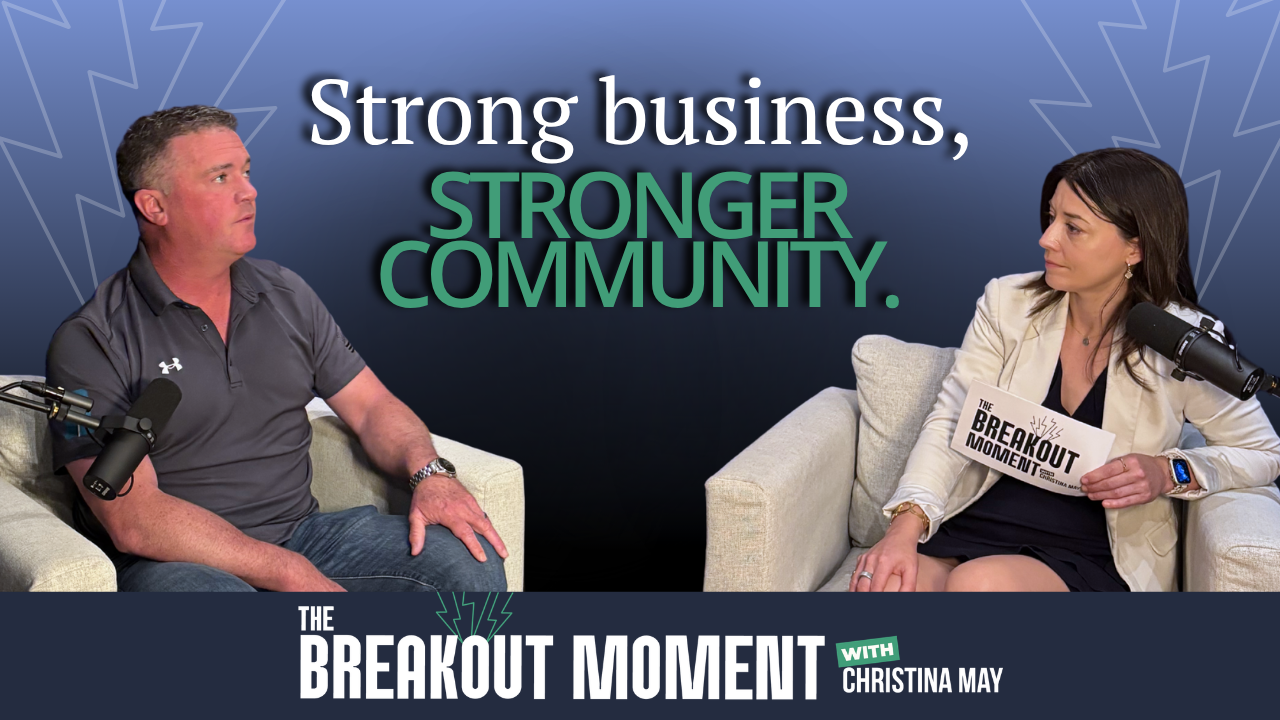
The Long Game: How Manifesting Talent Changed Everything with Mark Flavin
Christina is joined by Mark Flavin, founder of Titan Mechanical, who shares his unconventional path from early hustling and creative ventures to building a successful construction company. The episode centers on the power of recognizing and “manifesting” talent early, highlighted by Mark identifying and later recruiting a key leader who helped drive major growth. It explores the challenges of scaling a business, the importance of hiring the right people at the right time, and the balance between growth and sustainability. Ultimately, the conversation emphasizes that long-term success comes from strong relationships, smart decision-making, and surrounding yourself with the right team.
Christina May: Mark, welcome to the show.
Mark Flavin: Thank you.
CM: So happy to have you here. So, really wanted to kind of dive in today. Talking about not just your company, but it's a great story about how over the last 14 years, you guys have grown.
You're 100 people now, the services where you started, where you are, you've ended multiple businesses down now into where you are. I'll let you introduce your company and yourself just a little bit, and then we'll dive right into it.
MF: My name is Mark. I own a company called Titan Mechanical and Plumbing. My wife owns DC Supply, which, you know, she started to help our company out as well with supplies and things like that. But I've always been an entrepreneur. As a kid, I would sell. I actually got busted selling liquor in eighth grade.
CM: You were a rebel early.
MF: I've always been that, that entrepreneurial spirit, you know, like, I was in the military. I got out of the army in 2001, and right out of the army, I started another business with a friend, doing marketing for Asylum Lake City snow, which used to be a snowboarding and skateboarding company.
CM: You're kidding me. I snowboard on occasion, and the older you get, the more you think about it, like, do I really want to do this now, but I don't snowboard anymore. There's a reason those falls hurt.
MF: I’ll get on a longboard every once in a while. I did that for about three years or so. Most of the funds that we took from that, we actually started a film production company and started doing independent hip hop shows. I did about 150 of those around the DMV market and stuff like that. So I've always been an entrepreneur.
CM: How the heck did you end up in mechanical?
MF: Yeah, it was, well, I always loved construction. I like seeing that tangible product when it's finished. And, in between all of that, obviously, you know, a lot of that wasn’t making enough money for me to live. So I was working other jobs, and they were always revolving around construction.
I used to build houses for a company called Syntex Homes. Which is like a track builder. I was a construction manager with them. And then the market dropped, and I ended up getting into the mechanical field as a project manager, which I did for about five to seven years. Took all the bumps and bruises and great information and, decided to try it out on my own.
CM: Wow.
MF: That's how I kind of got the ball rolling.
CM: That feels very familiar to me. Very familiar. Similar stories. Although I don't have any hip hop or, you know, as an eighth grader, you know, selling alcohol in my past.
I was a little bit more, a walk in between the lines, not color.
MF: I bought my first BMX bike with that money.
CM: Oh, look at you, look at you, I love that, I love that. Do you bring any of that, you know, energy into… I mean, let's face it, mechanical fuel can be pretty dry. Do you bring any of that energy you feel into Titan?
We do. You know, the team and I are pretty diverse. But we remain energetic. The thing that I really like about the mechanical field is that it's always growing. It's always moving, like new technologies coming out, you know?
We don't shy away from a difficult project because it's different. You do the same thing every day. You want to try different things. You want to see if you can do it and do it to the best of your ability. Sometimes you will be the first to build something in your area that has that type of product on it or something like that. Those are pretty cool. I like doing that.
CM: Is that you feel like a little bit of a risk taker? So when you started out, you mentioned like, you know, your team's pretty diverse, you know, reflecting back on those beginning times, you know, what's that first notable risk that you took that you feel that really kind of popped you guys forward?
MF: My beginnings were that I used to do what they call base building and tenant fit-out. Whenever we first started, we would get some small contracts, you know, 20, 30, a hundred grand. And, you'd have to have 10 or 15 of those at a time going in order to really make revenue for the company.
In our first year, we did a little under one million, in our second year, we did about one million and six, and then jumped up to about four and jumped up to seven. And then, you know, kept going.
CM: That first million's the toughest.
MF: It is, but I was working as a builder for another company. And at the same time I was, I was, I would go into DC and unlock the doors and then go do my job and come back and lock all the doors and, you know, double check the work for the day, and then at night I would estimate, and I would sleep four hours a day.
I did that for about 2 years. And then we started making enough money that I was able to, you know, work full-time on my own. And, you know, my wife is a pharmacist by trade. And, after about, three, three years or so, she was able to stop being a pharmacist, and she was doing our books.
Full-time, the whole time. And so, a real turning point is, you know, needing to find the right people to, to believe in the vision that you have for the company. And, you know, I had hired, you know, a few people to, to help with project management, a couple for, estimating.
But the big turning point was when I hired my vice president of construction at the time. Tommy and I had worked years before at another mechanical firm, and I was a project manager. He was running projects in the field, and he'll tell you the same story. And, one day, I told him, I said, man, I'm gonna open my own business one day, and as soon as I do, we'll come find you.
CM: You manifested that.
MF: I did. And then, probably about 4 or 5 years later, I found him on a job site, and he was working for a builder. And, you know, I just walked up there and said, “Tommy, remember me?” He’s like, “Holy shit, man. Yeah, I remember you.” “So guess what? Buddy, I opened that business. Let's go.”
CM: Let's do this.
MF: We had a couple of beers that evening and sat down, and I mapped out the company and what was, you know, what we were doing there.
CM: Did you literally put it on a napkin?
MF: I didn't, but I've done quite a few bids on napkins. But you've heard those stories. That's construction.
CM: That is what we do. That's amazing. You knew from time before that that person was going to be special and key.
MF: Oh yeah. He's a special kind of fellow man. I guess that's the salt of the earth. Really, really understands and has passion for construction in general, not just a mechanical field, but it's also about how you treat people. You know, your customers, they treat the people that, you know, you work with every day and always have a positive attitude. You know, today might be a rough day, but tomorrow is going to be a better kind of thing. I knew from the time I met him that, you know, we'd, we worked together.
CM: That's amazing. You pinpointed this one person you knew, this person you hunted this person down on a job site. That's entrepreneurship, like, all the way, how did, like, what were the beginning stages? What did that look like for you too?
MF: I had already had a lot of initial processes and procedures in place, but the biggest thing was when you start a company, and you’re a family-owned business, the hard part is how do you scale to that next level? You're a three, $4 million company, $5 million company. And, you're doing great work, and people are calling you to do more work, but you can only take on so much that your company's growth is going to allow you to. The big question is not just how do I grow, but how do I grow smart, and how do I grow within the realms of my financial capability as well.
CM: That's a risk because, I mean, that's what I think is the hardest part, even the same thing for us. We're a service-based business. More work means more people. It's just the way it is. You can take on more work, but if you aren't really allocating those resources, you're going to wear out the great people you have.
We get into these horrible middle spots where it's not quite enough work to bring on more people. And those are really painful moments. And there's just these certain, I feel like cliffs of scale. It sounds great to scale. That's like buzzy to say, you know, but I always say to people too, it's like I don't measure success sometimes by the headcount. That's not how I measure success. You know, there's a reason it's, you know, more money, more problems
MF: One of the guys that I worked with in the past used to tell me that there are different levels of growth. And when you get to, say, 20 million, your profitability is great. This is 20 years ago.
CM: The numbers are all different and are different for different industries, too. I mean, I think what you were saying, you know, the $3, $4 million company for a different industry, that's the $300 to $400,000 company. It's a big difference between that and a million for them. So like a completely different industry. But it's the same break points.
MF: It is. Knowing when to bring people on so that you can scale is very tough. It takes a lot of thought, and you have to look at your vision and where, where do you want to be. You know, just because you get more revenue doesn't mean you're going to have more profit. We looked at that as a whole, and I knew for a fact that if I was to grow in scale, I had to bring more people into the company that could handle those phone calls and technical capabilities and, you know, manage the field. And that's where Tommy came in. Tommy's ability to handle general contractors and, you know, handle that side of the business for me.
While I could focus on the financial aspect, estimating, and the administration, the project management portion, and really kind of balance the company out, rather than constantly putting fires out and just waiting until the next fire happened. That was a must. I knew that that was the way that we would be successful. And bringing him in really helped us take off, as a matter of fact, he joined us in 2017. And in 2019, we got an award from Inc 500 for the Top 300 Company, you know, fastest growing companies in the United States.
CM: It just shows you, it tells the story. You're talking about 2017. He joined. That was an early moment for you in 2019. I think the other thing a lot of people are interested in is how to keep that momentum going. I think things I don't think we talk about a lot are not only keeping it going, but we regress like success is not a straight line. There are a lot of days I wake up, it’s like one step forward, and I don't want to count how many steps backwards I took. Can you talk a little bit about those challenges that came along the way, and then how he or others have helped the company kind of overcome those challenges?
MF: Well, there were definitely others. I mean, that's the point. Nobody grows a company by themselves. You have to believe in the people, and the people have to believe in you and what the company is trying to achieve. I meet a lot of people and, from around the way and from with one of my employees, they say, this is my boss, you know, I work for him.
It's actually the other way around. I work for my employees. So I try to always look at it in that aspect, you know, that I'm here working as hard as I can so that the company grows, the people with me grow. And so after I hired Tommy, my next, really big hire was Robbie Couch. And Robbie Couch and I have been old friends for years.
CM: Another friend. Did you poach this one off a job site, too?
MF: I did, and he was. No, he and I used to build houses together back in the day. That's how we met in the very early 2000s. He was always my check and balances guy, you know, I would call him up, you know, for instance, the first time I hit $1 million, I called him up, and I said, “Oh, man, I just got $1 million, man. I hit $1 million”. And he was like, “Oh, that's great. How much money do you make?” $10,000.
CM: Don't ask me that question.
MF: It took a little convincing, finally. But he came over in 2018. So a year after Tommy and, you know, we had two divisions at that point, and I had one that still did the tenant fit out and focused on base building, and then Tommy handles all of the multifamily. That's really what we focus on, plumbing and mechanical for multifamily. And Robbie, you know, did a great job at screwing away the tenant fit-out, retail, and base building portion. But we found that we were spending more time, energy, and resources on that side of the house rather than the one that made us the most revenue.
The whole 80/20 rule.
CM: Yes. Pareto’s law. All day long.
MF: It's a true thing. Before we started, I told you I listened to a lot of podcasts. Yes. I take, I take a lot from all those individuals that have learned before me, and I do a little nugget, you know, you a lot of times these these interviewers or speaking to people in industry that are billionaires and, you know, sold and made and built companies and things like that. But you know, if you read between the lines and maybe grab 1 or 2 of the little nuggets that they're putting out there. Those are the things that you take, you know. The little, little laws, a little rules, a little things that you can think back on and say, “Am I doing that?” “Is that something that I can improve on? “
You know, and the 80 20 thing is definitely one of them. Identifying that, we weren't focusing our growth on what could be versus what is now. And, we decided to pivot and, with Robbie there, he came into the office for a little while and really helped me move towards managing the project managers and in-house, with Tommy in the field, managing the field as we grew, it was a really great team. And we were able to scale tremendously.
CM: It really speaks to the power of the right people. I can't even think that all of us have been in, in these places where we know what we've made hiring mistakes. No, you know, I mean, there's only so much vetting you can do. You know, we're all human. So, a takeaway that could be really helpful for many people would be to know what to look for when hiring someone. Yeah, these are long-term relationships. You saw it. You knew. And you manifested that forward. But, you know, as you scale up to 100 people, it's obviously more than just to, you know what? When you're looking for something in someone, what are those like 2 or 3 traits that really stand out to you and, you know, in your gut? Because I know I hire, too. It's a gut feeling.
MF: Well, being in HVAC and plumbing, and construction in general, you don't really hire a lot of people who have a background in that, right?
CM: Right.
MF: Especially project management. Have you ever managed a multifamily mechanical? No, of course not. Most people have it. So when I would interview, I would always look for something that stands out, something a little bit different that they did rather than when I went to college or, you know, I was in the military or, you know, I had a couple of jobs doing x, y, z. I always ask, well, you know, “What do you do for fun?” “Was the last thing that you did that really excited you?” You'll get some pretty neat answers. One of my, one of my lead project managers right now, the main reason I hired him was that during the summers when he was in college, he would go up to Alaska and work on fishing boats, you know?
CM: Oh, wow.
MF: I was like, that is out of the box thinking. And, you know, that is an awesome adventure. And you said to yourself, I'm just going to do this, you know, and he would, he said he would go up there, and he wouldn't have a job in place. You just walk the docks and find out who you know needed help.
He would jump on the boat. And that's how he made his money in the summer. He’s still with us today and is one of the best hires. I just had a guy walk in today, as a matter of fact, for an interview, for our plumbing side. And he spent the last four months in Antarctica working out there as a contractor doing plumbing. So you're hired.
CM: You're hired, and it's funny, it's those outside experiences that I think people don't realize. It's everything that you bring with you to the table, not just what your resume says.
MF: That's right. It's the individual and how they were able to interact with you. If you're doing an interview with somebody and they're extremely timid, you know, they're not kind of opening up with you. And I understand that, you know, it is nerve-racking to have an interview. If you have a good rapport, and you're able to communicate and, you know, really get your point across, and be able to talk with someone else. The industry today, whether it be construction or anything else, is built around communication. And that's one of the biggest skills.
CM: Any industry anywhere.
MF: If you can't talk to people, you're not going to be successful. So that's something else. You know, being able to really be open and just to have a good discussion.
CM: I think that's a great place for us to wrap up. Thank you for being on. I think everybody here will be able to take away, whether it's when you recognize someone, even if you don't know who or where they're going to fit in your future, kind of keeping that person in the back of your mind and knowing when that puzzle piece fits at the right moment. Can be the only little piece that it takes.
MF: That's it. I could also leave with this. One of the best things that I ever did was marry my wife, you know, because the partner that you choose in your life to take you from A to B, and A to C, and from B to C is crucial.
You know, having that support system behind you, no matter what employee you hire or the people that are in your life at work, if your home life is disruptive and you know you don't have that success behind you at home, then you know failure is typically the outcome.
CM: I could not agree with you more. All right. Well, until next time.
MF: Thank you very much.
CM: Thank you for coming on. Thank you.